Why Isn't My Offer Selling? Fixing a Checkout Page in Five Minutes
Can't Figure Out Why Your Offer Isn't Selling?
Ren Benedicto has x-ray vision that sees what's broken in a launch.
She's a copywriter and launch strategist who built an offer called Launch Catalyst: a deep look at your launch data, a 40-minute call, and the one change that'll help you sell more next time you launch your offer.
At $297 it's a steal and exactly what her audience needs.
So why were buyers hesitating?
She sent her sales page / checkout page to me for a Five-Minute Feedback review*, and asked the question a lot of us are asking right now:
Why isn't my offer selling when the price is fair and the outcomes are clear?
What's already working
Ren does a great job explaining the outcomes of what her buyer would get.
The page is clear about deliverables: clients get a diagnosis of what didn't work in their launch...
the one thing that will change everything for the next one, and a call to walk them through it.
Lordy! For someone who just ran a launch, getting all of that for $297 is the deal of the century!
Ren's offer isn't the problem.
The problem is her x-ray vision sees what's not working in someone's launch with so much ease, it's like breathing.
Explaining what her audience needs to hear is not. Because when we're an expert in our thing, we skip over those words because to use they're implied.
That's a positioning problem. Let's talk about how to solve it.
Problem #1: The name makes people guess
"Launch Catalyst" sounds like where you start in your launch. Like something you buy before you begin to get things moving.
Ren's buyer just finished a launch.
They know they should go back through all that data, but it's the last thing they want to do, because now they have to deliver the program they just finished selling.
It's not a 'catalyst' moment; it's a moment for review.
I called it her "X-ray moment", where Ren looks at the data and sees a hole here, a hole there, then tells the client how to plug them.
The name should say something to help the audience get what it is before they read a single line of the page.
Something like 'The Laser Launch Fix'.
Problem #2: The problem / struggle isn't set up enough
The copy moves pretty quickly from "you don't need a list of changes" to "imagine handing this off."
Slow down to remind the reader about their situation:
They've just come off a launch, the data needs to be analyzed, and it's the last thing they want to do.
For Ren, it's the first thing she wants to do. She loves it!
That contrast is the selling point.
"Imagine handing all of that off to someone who loves doing it, and getting it back with your exact next steps."
Naming the pain isn't about being manipulative. It's about saying what your reader is already feeling so they know you understand why it needs to be taken off their plate. Now.
Problem #3: Little bits of friction are stopping the Yes
Two small things on the page could make someone pause.
The first is the intake form directions.
She says she gives them "a list of data you need to pull", which sounds like a lot of homework for someone who's wiped out and maybe doesn't know where to find it.
So flip it.
Say you'll tell them exactly what you need and all they have to do is send it over within X days.
It's the same ask but now the reader feels taken care of instead of handed a to-do.
The second is the price. I originally read the page and thought the offer was $197, then realized it's $297.
The $197 thing turned out to be the Catalyst Playbook, which is an add-on with a similar name.
What's the difference between the two?
The buyer doesn't know and that confusion holds them back from buying.
If something is an add-on, say it's an add-on. Make it obvious what's included in the main offer and what's extra.
The real fix
When you're the expert, the fix usually isn't adding more.
It's stepping back, seeing where you've made assumptions, and saying the obvious-to-you thing your audience needs to hear.
Steal this for your own page
Open your sales page or checkout page and ask yourself:
- Would someone who isn't me understand what this is and why they need it in the first ten seconds?
- Does the name tell them what it does, or just sound impressive?
- Have I described what they're feeling right now before I describe what they get?
- Is there a "to-do" hiding in my process that I could reword as "I've got you"?
- Could any price or add-on make someone stop and wonder?
Can't see it for yourself?
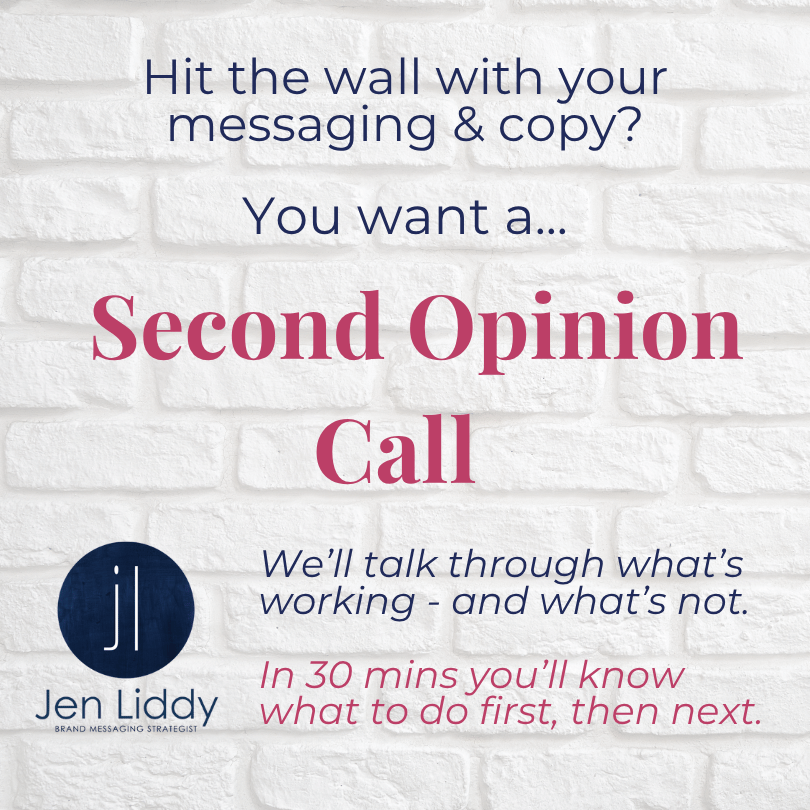
That's the whole reason the Second Opinion Sessions exist.
It's 30 minutes, one-to-one where I show you what's not working, why, and how to fix it.
If I can get you this much clarity in five minutes, imagine what I can do in 30.
Want your own sales page or web copy reviewed in a future Five-Minute Feedback?
Join my list - the button is below. Calls for submissions go out there first.
WHO'S BEHIND THE SCENES HERE?!
Hey, I'm Jen Liddy 👋
A messaging strategist with 10+ years of experience helping experts say what you mean and get your audience to take action.
Before that, I spent 15 years teaching English, analyzing and diagnosing communication problems for my students...
which is how I can spot what isn’t working and get precise about fixing your message - quickly & easily.
I'll show how to say what your audience needs to hear AND still sound like yourself...
Because they need your expertise and want their problem solved...
And you're the one to help them.
Let's get yours sorted out in 30 minutes with a Second Opinion Call.